
Skip to primary content
Skip to secondary content

SCAD Architecture VOICES

Thoughts on Architecture & Urban Design from Faculty & Students

SCAD Architecture VOICES

Main menu

  • Home
  • About SCAD Architecture & Urban Design

Category Archives: Professional Engagement

Architecture Meets Game Design: Exploring Savannah with City Engine and Interactive Data Visualization

Posted on 2017-08-21 by Elaine Adams

by Dean Ivan Chow, AIA, NCARB
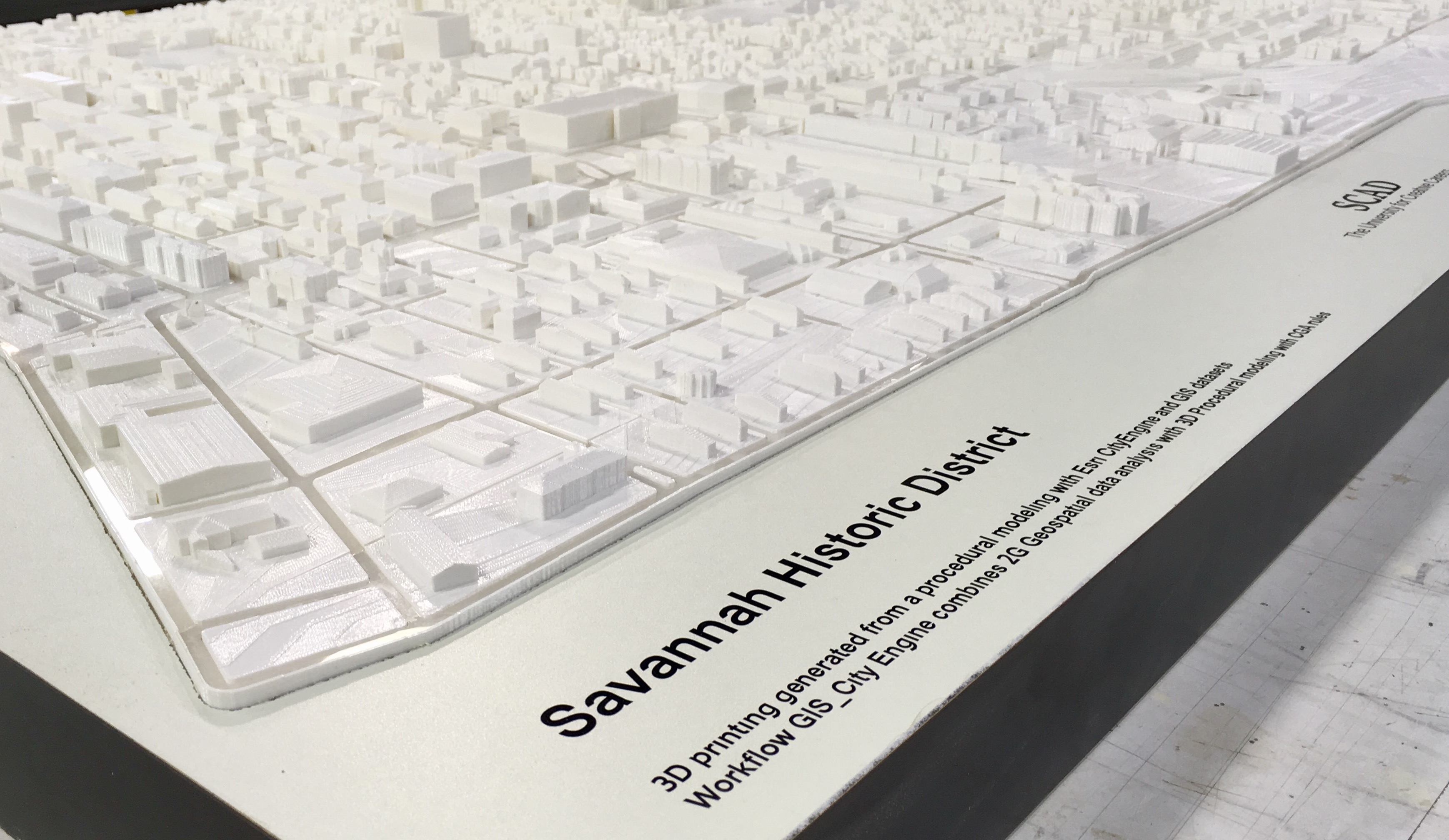
An exciting new pioneering initiative gives SCAD students the opportunity to become dynamic visualization artists who are technically proficient in visual design aesthetics that synthesize ‘big data’ in solutions for emerging design needs while reaching broader audiences with compelling user-friendly experiences.

SCAD’s unique collaborative partnership with Esri, the world’s foremost designer and supplier of GIS software, brought SCAD students and faculty to the 2017 Esri Federal GIS conference in Washington, DC on February 13-14, 2017, attended by over 4,000 federal employers. In a unique display of SCAD’s innovative prowess, students led by architecture and urban design professors Christine Wacta and Ryan Madson and chair of interactive design and game development chair, SuAnne Fu, displayed a dazzling array of experiences combining GIS mapping, 3D-modeling and interactive visualizations.

Christine Wacta and her students generated City Engine files from which SCAD’s Digilab printed a 3-demensional 1:1500 scale model of downtown Savannah demonstrating GIS as powerful means of visualizing, analyzing, and interpreting data. Using this means of mapping, organizations can recognize relationships, patterns, and trends in profound and impacting ways. The 24 SF 3-D model was displayed in the “drone zone,” where drone operators experimented with scanning technology, showcasing 3D printing as an emerging tool for urban planning and design. This was the first time a working model of this scope, accuracy and flexibility was displayed at a GIS conference.

SuAnne Fu guided students to create a stunning exhibition of both virtual and augmented reality experiences for conference attendees. Her team brought together two experienced faculty from separate digital media disciplines: interactive design and game development professor, Aram Cookson and visual effects professor, Bridget Gaynor to lead the courses. With their combined expertise, the students created a unique data visualization program which allowed users to enter an augmented reality environment using a Microsoft HoloLens or a virtual reality environment using an Oculus headset. The AR model allowed users to scale the city and visualize data in different categories. The VR program allowed users to explore the city of Savannah and view data through voice-command data filters. This cutting-edge approach to interactive data visualization was so impressive that even Esri’s software developers were impressed.

 “I am a current software developer at Esri, and was fortunate enough to meet the group of SCAD students presenting their VR demos at FedGIS this past week. I had the chance to interact with their Unity and Unreal Engine-based demos, and it was an incredible experience. As a developer who dabbles in VR, it was personally exciting. But, to see the application potential using GIS made me ecstatic!” – Jackie Roberts, Software Developer, Esri DC

Following the FedGIS conference, Professor Wacta and chair of the motion media program, Kelly Carlton, successfully developed live demonstrations of the use of projection mapping at both the Esri Imaging and Mapping Forum (IMF) and the 2017 Esri User Conference that were held in San Diego July 10-14, 2017 and attended by over 16,000 design professionals and students. The response has been nothing short of remarkable.

Ivan Chow is Dean of the School of Building Arts at SCAD.

Posted in Professional Engagement, Urban Design

Professional Licensing: The FINAL Final Exams

Posted on 2016-02-23 by SCAD Architecture

by Prof. Melanie Parker Dameron, E.I.T.

Furbaby MelanieOh, the professional licensing exam! As a student or graduate of an architecture or engineering program and an aspiring design professional capable of stamping your own designs, you are well aware of the challenges these exams bring. You’ve finished your education and racked up the required experience, and now it’s time to knock the dust off those books and get back to studying. For weeks — or even months — you prepare for that first exam, studying late into the night after working all day. (And you thought those structures exam all-nighters were tough!)

I know for myself, making time to study was (and still is) difficult, and the road to licensure has definitely had its challenges. After working all day, the last thing I’ve wanted to do is listen to lectures, read review material and run through practice problems, but I’ve learned a few things along the way. Preparing for exams requires several things that are no-brainers to most, but we can all use a friendly reminder at times. Here are some of the things it’s going to take:

Hard work.  First, anything worth having takes hard work. Obtaining a license in field like architecture or engineering is at the very least important but perhaps a necessity depending on the career path you choose. You have to make the decision to put your head down and work to reach your goal, reading and studying even when you simply do not feel like it.

Sacrifice. It goes without saying, but if you’re preparing for an exam that requires the hard work already mentioned, it is going to require sacrifices. There will be times your friends are going out and you would love to go along, but you’ll need to make the wise decision to stay home and study. You will undoubtedly miss out on some things, but you’ve got to remember the sacrifices are only temporary. Check your priorities and, if there are things you simply cannot miss, make adjustments as required to get your preparation done.

Discipline. You can also think of this one as persistence or focus. You know the old saying about mind over matter? Well, you have to focus on your goal of being licensed and shut out all distractions. It may take locking yourself in your office to force yourself to study, but you’ve got to do whatever it takes to make sure you’re prepared when the big day comes.

Practice. Of course, you’ll need to complete practice problems, but you’ll also need to simulate the exam environment to prepare for the stress of and any other challenges that may arise during the actual exam. The more you practice completing problems, the faster and more effectively you’ll be able to think through and complete problems on the exam. When you simulate the environment, you’ll condition yourself to perform well under exam day pressures.

Celebrate. Yes, celebrate! Set milestones along the way. When you complete a certain number of problems or read a certain number of chapters, reward yourself with a break. When you pass your first exam, celebrate the progress you’ve made. This is one of many small victories on the way to achieving your ultimate goal – professional licensure.

These are just a few of the important things to keep in mind as you prepare for your licensing exams. Because I’m in the process of studying for my last exam as I write this, I’m sharing some of the things that I’m doing or have found to be helpful. The feeling of passing an exam is priceless and totally worth every sacrifice you make to get there. But after passing the first exam, you’re not finished! It will be time to get back to the grind and prepare for the next one.  With that said, I’d better get back to it and my furbabies, who keep me company in this journey!

Melanie Parker Dameron, E.I.T. teaches Structural Engineering at SCAD School of Architecture. 

Posted in Design and Life, Professional Engagement

TEN Job Hunting Tips For Architecture Students

Posted on 2016-02-04 by Elaine Adams

Royalty-free 3d computer generated business graphic of a group of businessmen in colorful shirts, carrying briefcases and holding their resumes up at a job interview. It is a full-color employement clipart picture on a white background.

It’s THAT time of year again, architecture students! If you haven’t already found your summer internship, get on it now. Look close to home, in a city that intrigues you, or internationally. Be brave! Here are ten tips for landing that great job:

1. Participate in Professional Organizations.

The American Institute of Architects (AIA) is the professional organization for architects. Join. AIA Knowledge Communities cover whatever topic you are drawn to as a future professional. The AIAS is the student arm dedicated to networking, growing and sharing knowledge, and improving architectural education. Every architecture school has an AIAS chapter. Serve on a board, organize an event, or just participate. It shows you’re committed to the profession.

The US Green Building Council (USGBC) offers phenomenal networking and education opportunities for young architects interested in sustainable design. Unless you’ve been living under a rock, you’re designing green buildings and cities in studio. USGBC hosts educational and networking events focused on better buildings and a better world. Student membership for these organizations is very affordable. Do it.

2. Quit Smoking.

Quit smoking, seriously. Architects work long hours, physically close to each other, and nobody wants to work next to an ashtray. If you don’t think you smell bad, think again. If you smell like cigarettes for a job interview with a high end firm, you will not get the job. Period.

3. Publish!

Write! We publish our own blogs, books, and newsletters at the click of a mouse. Contribute to an existing blog page (like SCAD Architecture VOICES!) and include links to your articles in your resume. Make them hyperlinks for the PDF version. Write humor, research, observations, or whatever interests you personally. Share your posts within your social and professional network to build traffic and readership! Demonstrating you have a global or national voice and know how to write is very attractive to potential employers. You are engaged and you care.

4. Learn Revit.

No architecture firm wants to teach you Revit. Learn it. Know it. Revit dominates US architectural practice and is making its way across the globe. Firms win the project with SketchUp and Rhino, but they do the project in Revit. Knowing how to create a “money shot” with Rhino is cool, and it definitely helps in some firms, but you must know how to work in the trenches.

5. Earn Professional Accreditations and Training.

Differentiate yourself! Earn LEED accreditation, complete the Autodesk Building Performance Analysis Certificate (BPAC), take certificate courses from the National Charrette Institute or Form Based Codes Institute. There are thousands of architecture students out there trying to get a job along with you. The candidates with credentials that prove they know best practices in sustainable design, building energy modeling, daylight, and ventilation are the ones who rise to the top of the pile. You know how to design and run a charrette? Fantastic. You are a valuable employee. Your school doesn’t offer this kind of opportunity? Transfer to SCAD Architecture.

6. Enter Design Competitions.

Put yourself out there. Design competitions abound in our profession. Architects LOVE to compete. Our studios enter competitions at SCAD, and don’t hesitate to enter competitions as in individual. You never know what might come of it. Money! Fame! Recognition! Jobs! Free Sandwiches!

7. Polish Your Online Image

Google yourself. Prospective employers will Google you, and that includes images. Check your privacy settings for social networking. Nobody but friends should see or read your posts. You can untag yourself from incriminating photos. Do it even if you’re not looking for a job. Your mother will thank you.

Join LinkedIn and complete your professional profile. The site is kind of boring, but it has replaced the Rolodex (If you don’t know what that is, look it up.) Link to speakers you enjoyed seeing or architects and firms you admire. If you travel during break, see who in your network you might meet for coffee. Busy professionals are surprisingly approachable over a cup of coffee.

8. PDF Your Gorgeous Portfolio.

Crafting a beautiful and artistic portfolio is good art therapy, but the reality is that you will most likely submit your portfolio as a PDF. Make it artful and professional. Check spelling. Don’t provide too much narrative; let the images tell a story. Consider uploading it for free to a portfolio/magazine publishing website like Issuu. Print it to assure it prints well with clear images even after reducing file size. Make sure the file size is reasonable. Don’t know how to craft a gorgeous portfolio? Ask a SCAD Architecture student.

9. Check Your Resume, Then Check It Again.

There will be NO spelling or grammar errors in your resume. If there are, your resume will go immediately to the bottom of the pile or directly into the trash. When I filtered intern resumes, they went into the trash. Get a friend and a teacher to proof it for you. Take advantage of your school’s writing workshop or career services staff to proof it with you. Do not do this alone.

Include all of your relevant accomplishments, activities, blog posts, and conferences attended in your resume. Do not make it boring. Don’t hesitate inserting an image of your work somewhere in the resume. We’re the creative class; we’re allowed to go beyond Times Roman fonts and dry chronological lists. Ask your teachers and friends if you can see his/her resume. I love seeing my friend’s resumes.

10. Write a Thoughtful Cover Letter.

Know the firm. Mention a specific project that you particularly find interesting or want to learn more about. Tell them you WANT to work with them because of something that intrigues you about their practice. Do not wait for job postings; send your resume and tell them who you are. Tell them why you’d be a great fit for their office culture. Make the letter only one page long. Check the letter, and check it again, just like your resume. You can start with a template, but make sure you don’t leave stray information from the last firm you wrote. That’s not good. 

Get out there and find an awesome internship! You’ve got this.

Posted in Design and Life, Professional Engagement

This is Architecture – Not Tinder

Posted on 2015-09-17 by SCAD Architecture

Architecture Tinderby Scott Singeisen

Architecture in the media used to be different; once a month the publishers of refined and respected professional journals and magazines shared information on newly completed works of architecture to the awaiting public. Before these works of design would be included in the pages of a magazine, the editorial review board juried the work for the same issues many architects and academy faculty members may recognize: success relevant to site, program, technology, design fundamentals, and theory. Architecture presented in the pages of these publications were in turn poured over by readers, studied, evaluated again, and considered. On many occasions, publications received well-written letters in support, or critical of, the works presented. This was our relationship with design media.

Then everything changed. The internet changed the expectation and satisfaction of this relationship. With the advent of websites as extensions of magazines, and newly formed web-zines to specialize in any of our shared community interests, the production and consumption of imagery became self perpetuating. But, it’s not about you or me – it’s about the kids.

The supposition is that media promotion of architecture through imagery alone is damaging the education process of architecture students as they now think of design analysis as a process of quick satisfaction, rather than an in-depth relationship. The pleasure a viewer obtains searching the many websites catering to architects and designers in search of inspiration is ultimately unfulfilling as a shallow and cursory evaluation of the information available which reveals a design without narrative – a lack of relationship. If the viewer is only looking at a photograph and not evaluating plan and section; material and envelope detail; process or site and context, then the relationship has begun with a cheap one-night stand. Unable to translate the lessons of the research and analysis, the design audience is forced into conjecture.

If the image viewer is responsible for discerning good design from bad design, we cannot blame the fractured relationship on the image supplier. Viewers must analyze a large amount of information in context in a very short period of time. If viewers are not prepared with precedent to build this analysis due to a post-modern educational system, then we must revisit the methodology and pedagogy of our academies.

We can begin by teaching and practicing better manners of critical thought. Educational institutions can return to the classic educational organization of the trivium; consisting of three parts in the following order: grammar, dialectic, and rhetoric. To be clear, I do not introduce classical education as a style reference, but as an educational paradigm from which other specialists can elaborate. As I know the three parts of the trivium are defined as such: grammar relevant to language, the structure of the language, and as a means of communication; dialectic relevant to how the language is used to support an argument in the affirmative or negative; lastly rhetoric relevant to the expression of design ideas poetically and with sophistication. All three of these parts are easily translated to the architecture principles of form, order, space.

A process of rigor and criticality – potentially a lack of awareness of – is largely absent from the evaluation of architecture imagery. Dispersing architecture and design imagery through the Internet has a place in our culture, but rigor and criticality of evaluation must be viewed as a lens. Media promotion of architecture should be prepared to present a full ‘trivium’ of information for each project, and viewers should be prepared to critically translate the information. This is architecture, not a one-night stand.

Scott Singeisen is a professor of Architecture & Urban Design at SCAD.

Posted in Design and Life, Professional Engagement

Collaborating with Academic Creatives

Posted on 2015-08-24 by Elaine Adams

Have you ever wished you could engage a room full of energetic, creative people to help solve a problem for your company? Design charrettes, scrums, ideation, integrative design, public engagement, and systems thinking are all within the realm of the creatives. Here we are! Students and faculty are available to you all over the world.

SCAD presented “Radical Collaboration” at the 2015 AIA Convention in Atlanta with the largest webcast audience of the Architect LIVE series this year. Projects like the Professional Practice Game and SCADpad open doors for students and practitioners.

Boundaries between college and professional practice are blurring. Higher education is partnering with private industry more than ever before, and SCAD is leading the way in the creative fields. Our Collaborative Learning Center (CLC) has set a high standard through projects for industry leaders such as Rubbermaid, Fox Sports, Coca-Cola, Hewlett Packard, and many more. In addition, Individual instructors often partner with public entities and practitioners to enhance students’ learning experiences. Most universities are open to all types of collaborative projects. I think SCAD students bring exceptional creativity to the table that other universities only wish they could offer.

SCAD’s diverse fields of study provide us with remarkable opportunities for integrative solutions to complex problems, whether tackling design challenges or thinking in systems. A new school year is starting all over the country, and it’s a great time to engage students in problem solving. At SCAD, we are able to respond to outside opportunities quickly and blend them into coursework within a short time frame.

Our students have participated in energy-infused weekend design charrettes for architecture, interiors, urban design, fashion, graphics, and more. We’ve provided long-term collaborations, partnering with corporations and professionals. We don’t compete with practitioners but love working with them. Like any professional service, we request compensation, largely operating costs. Students are not usually paid for their work, but do add valuable work to their portfolios.

Fall quarter begins at SCAD in mid-September! (We do love the quarter system.) Give us a call or drop us a note. We want to collaborate with you!

Posted in Professional Engagement, Uncategorized

Recent Posts

  • Parachute Drop Into SCAD Lacoste – Oooh La La
  • The Integrated Path at SCAD: Year One!
  • Architecture Meets Game Design: Exploring Savannah with City Engine and Interactive Data Visualization
  • The Integrated Path: SCAD and Georgia House Bill 41
  • Designing for a Cycling Community of Feedback Loops

Recent Comments

  • Lucas Gray on I Am Not Going To Be An Architect.
  • Cedrick Bijou on I Am Not Going To Be An Architect.
  • D. J. on I Am Not Going To Be An Architect.
  • Michael Riscica on I Am Not Going To Be An Architect.
  • Stanley Turner on I Am Not Going To Be An Architect.

Archives

  • November 2017
  • October 2017
  • August 2017
  • May 2016
  • March 2016
  • February 2016
  • November 2015
  • October 2015
  • September 2015
  • August 2015
  • May 2015
  • April 2015

Categories

  • Climate Change
  • Design and Life
  • Faculty Bio
  • IPAL
  • LEED
  • Living Building Challenge
  • Professional Engagement
  • Project Management
  • Student Blogs
  • Sustainable Design
  • Uncategorized
  • Urban Design
Proudly powered by WordPress